When Co-Executors Disagree in Alberta: Rights and Solutions
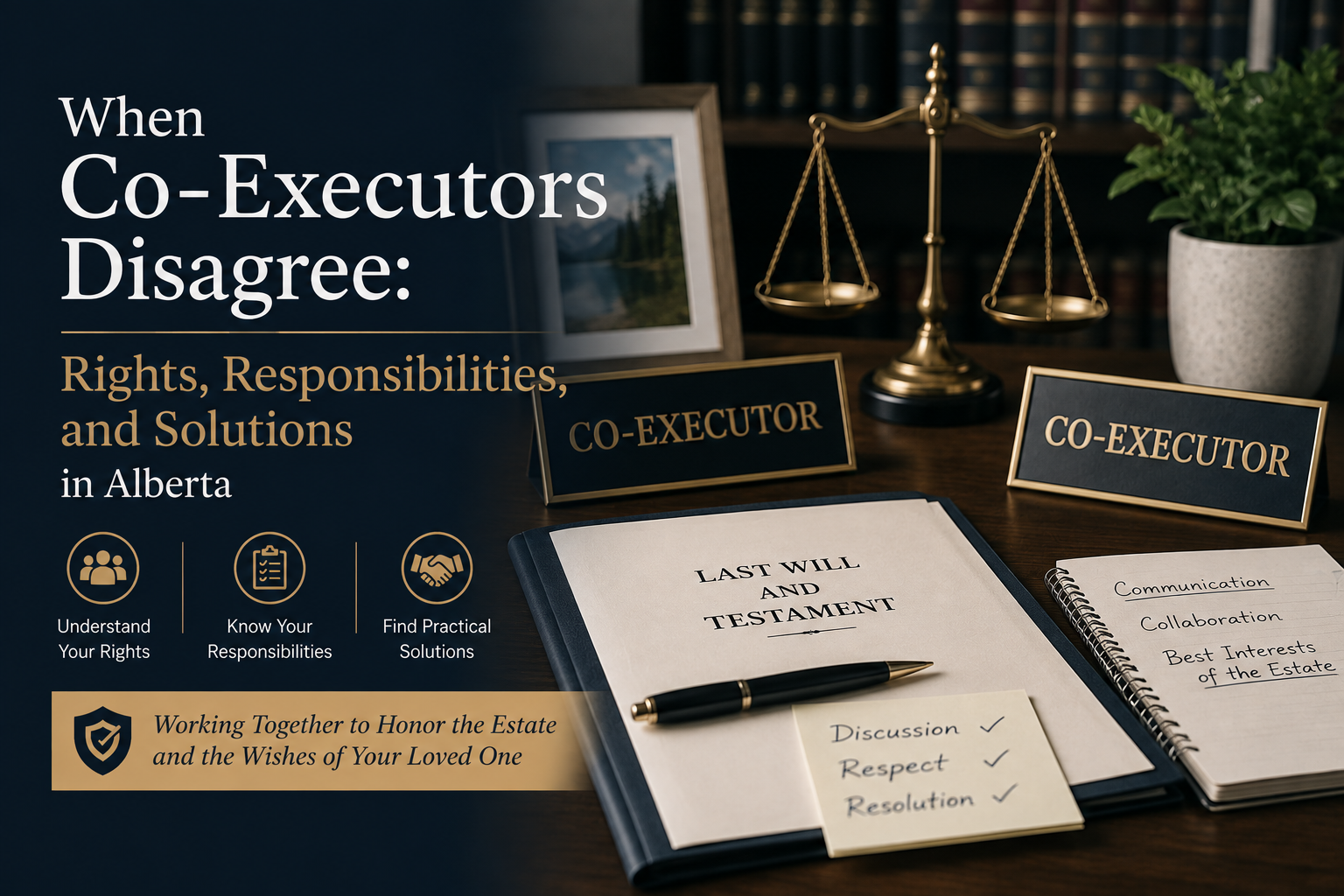
Many wills name more than one executor — often two adult children, or a spouse together with a child. The idea is usually to share the workload and provide a natural check and balance. It can work beautifully. But because co-executors generally have to act together, a serious disagreement between them can bring the administration of an estate to a standstill. Here is how it works in Alberta, and what can be done when co-executors do not see eye to eye.
How co-executors are supposed to work together
Unless the will says otherwise, co-executors must generally act unanimously. They share authority equally, and neither one can make major decisions or deal with estate property on their own. In practice, this often means both signatures are needed on estate accounts and major transactions. That shared authority is exactly what creates a problem when the two cannot agree.
Common sources of conflict
- Whether to sell or keep property — especially the family home
- The timing and amount of distributions to beneficiaries
- Valuations of assets and how they are divided
- Executor compensation and who did more of the work
- One executor feeling the other is not pulling their weight
- Old family history that resurfaces under stress
Their shared responsibilities
Co-executors owe the same fiduciary duties as a single executor. Each must act honestly, in the best interests of the estate rather than their own, keep proper records, and keep the other informed. Neither can simply go quiet or freeze the other out. Ongoing communication is not just good manners — it is part of the job.
What happens in a deadlock
When co-executors cannot agree, estate administration can grind to a halt: bills go unpaid, property sits unsold, and beneficiaries wait. That delay carries risk, because executors can be exposed to personal liability if their inaction harms the estate. A deadlock is not a stable place to stay — it usually needs to be resolved, one way or another.
Ways to resolve disagreement
- Communication and compromise — often the fastest and cheapest path
- Bringing in independent professionals (a lawyer, accountant, or valuator) to take the emotion out of a decision
- Mediation with a neutral third party
- One executor renouncing or stepping down, if they are willing
- Applying to the court for advice and directions on a specific decision
- As a last resort, applying to remove a co-executor who is acting improperly
Preventing the problem when you write your will
The best time to avoid a co-executor deadlock is when the will is being written. Options include naming a single trusted executor, choosing people who genuinely get along, or including a clause that allows executors act by majority or that names a tie-breaker. These are exactly the kinds of choices worth thinking through when you consider what goes into your will. Getting the appointment right at the start prevents most disputes later.
Frequently asked questions
Can one co-executor act without the other?
Usually not for major decisions. Unless the will allows executors to act individually or by majority, co-executors must generally act together, and both approve significant steps.
What if co-executors can’t agree on selling the house?
They can seek independent advice or mediation, apply to the court for directions, or, if one is acting improperly, consider a removal application. Doing nothing risks liability for delay.
Can a co-executor step down?
Yes. An executor can renounce before taking on the role, or apply to be discharged afterward. The remaining executor or an alternate then continues, subject to the court’s requirements.
Caught in a co-executor dispute? Libra Law helps Calgary and Alberta executors and families find practical solutions — and helps you draft a will that avoids these problems in the first place. See our wills and estates services, call or text +1 (587) 438-2051, or contact us.
This article provides general information about Alberta law and is not legal advice. Every situation is different. For advice about your specific circumstances, please speak with a lawyer at Libra Law.
