Shareholders vs Directors vs Officers Canada
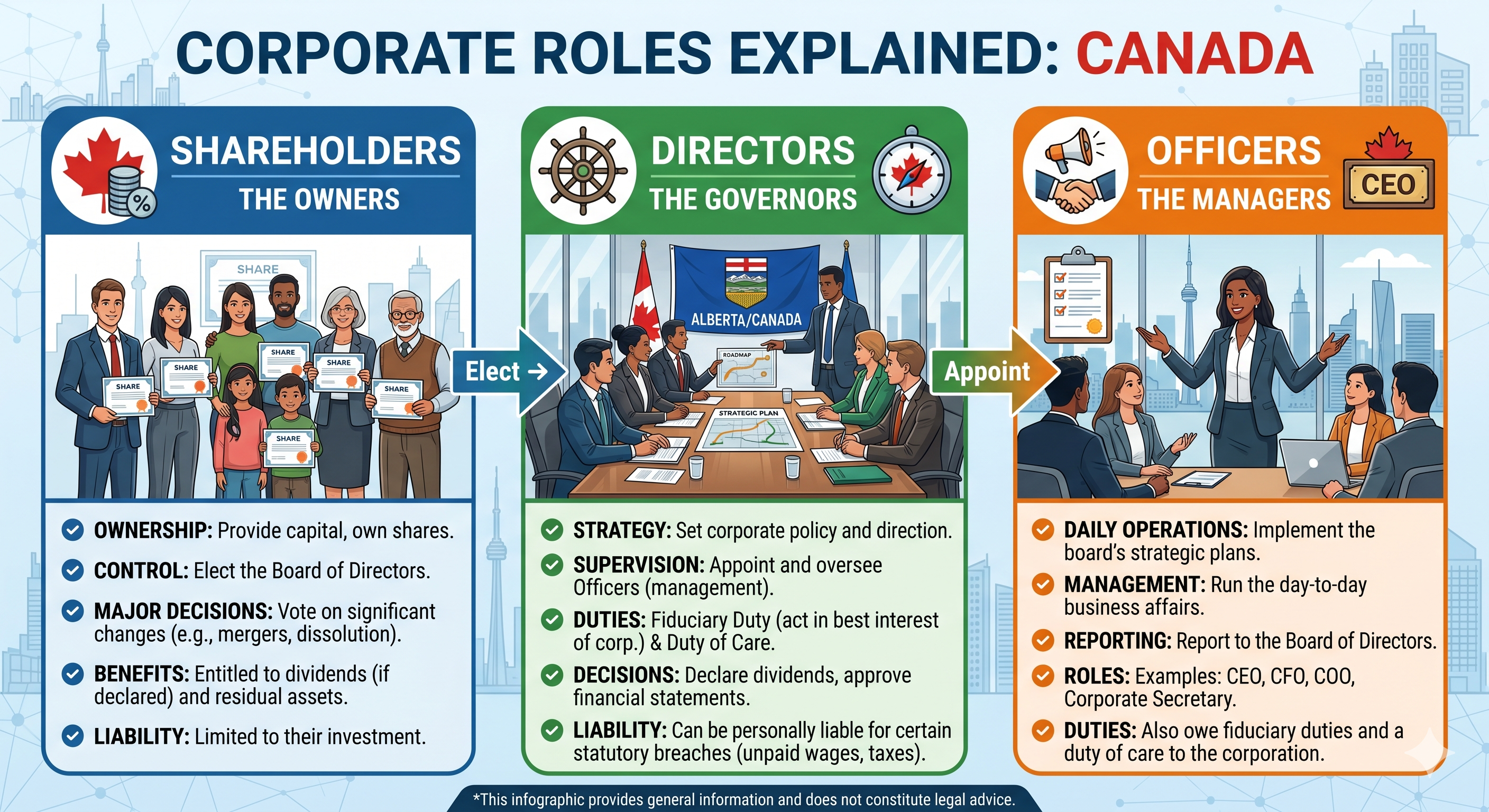
When a business incorporates in Canada, it becomes a separate legal entity. That corporation may have shareholders, directors, and officers, but these roles are often misunderstood.
In many small businesses, the same person may wear all three hats. One person might own all the shares, serve as the only director, and act as president of the corporation. In larger corporations, these roles are usually divided among different people.
Understanding the difference matters. Shareholders, directors, and officers do not all have the same powers, responsibilities, or legal risks. Confusing these roles can lead to poor decision-making, incomplete corporate records, shareholder disputes, and personal liability concerns.
Libra Law helps business owners, professionals, directors, shareholders, and corporations understand corporate structure, governance, records, and responsibilities before problems arise.
What Is a Shareholder?
A shareholder is a person or entity that owns shares in a corporation.
In simple terms, shareholders are the owners of the corporation. They do not own the corporation’s assets directly. Instead, they own shares that represent an ownership interest in the corporation.
For example, if a corporation owns equipment, bank accounts, vehicles, inventory, or real estate, those assets belong to the corporation. The shareholder owns shares in the corporation, not the corporation’s individual assets.
This distinction is important for liability, tax planning, estate planning, business sales, and shareholder disputes.
Shareholders may include:
- Individual business owners
- Holding companies
- Family members
- Investors
- Business partners
- Trusts
- Other corporations
The rights of a shareholder usually depend on the type and number of shares they own, the corporation’s articles, bylaws, shareholder agreements, and applicable corporate law.
What Do Shareholders Do?
Shareholders do not usually manage the day-to-day business of the corporation.
Instead, shareholders exercise ownership rights through certain major decisions. Depending on the corporation, shareholders may have the right to:
- Elect directors
- Remove directors
- Vote on certain major corporate changes
- Approve amendments to corporate documents
- Approve certain reorganizations or sales
- Receive dividends if declared
- Review certain corporate records
- Receive financial information in some circumstances
- Participate in shareholder meetings
- Sign shareholder resolutions
In many small private corporations, shareholders may also be directors or officers. But legally, those roles are still separate.
For example, when the person is acting as a shareholder, they are exercising ownership rights. When they are acting as a director, they are making governance decisions. When they are acting as an officer, they may be managing the corporation’s day-to-day operations.
What Is a Director?
A director is responsible for supervising the management of the corporation.
The board of directors is the decision-making body responsible for the corporation’s overall direction. Directors are not simply symbolic names on a corporate filing. They have real duties and potential liability.
Directors may make decisions about:
- Corporate strategy
- Major contracts
- Financing
- Hiring senior management
- Issuing shares
- Declaring dividends
- Approving financial statements
- Calling shareholder meetings
- Maintaining corporate records
- Corporate policies
- Major business transactions
- Compliance with corporate obligations
Directors must act carefully because they owe duties to the corporation. They are expected to act honestly, in good faith, and with the care expected of someone in their position.
For more information about director responsibilities, read Libra Law’s guide on Directors’ Duties and Liability in Alberta.
What Is an Officer?
An officer is usually responsible for the day-to-day management of the corporation.
Common officer titles include:
- President
- Vice President
- Chief Executive Officer
- Chief Financial Officer
- Secretary
- Treasurer
- General Manager
Not every corporation uses all of these titles. Some small corporations may only appoint a president and secretary. Others may have multiple officers with clearly defined responsibilities.
Officers are typically appointed by the directors. Their authority may come from the corporation’s bylaws, director resolutions, employment agreements, or officer appointments.
Officers may be responsible for:
- Managing daily operations
- Signing contracts
- Hiring staff
- Managing bank accounts
- Overseeing finances
- Implementing board decisions
- Maintaining records
- Reporting to directors
- Handling customer, supplier, or employee issues
In a small corporation, the same person may be the sole shareholder, sole director, and president. Even then, it is important to understand which role that person is acting in when making decisions or signing documents.
Shareholders vs Directors vs Officers: The Simple Difference
A simple way to understand the difference is this:
Shareholders own the corporation.
Directors supervise and make major decisions for the corporation.
Officers manage the corporation’s day-to-day operations.
These roles work together, but they are not interchangeable.
For example, shareholders elect the directors. Directors appoint officers. Officers carry out the corporation’s business under the authority given to them.
When these roles are not clearly understood, confusion can arise about who has authority to make decisions, sign contracts, access records, issue shares, approve spending, or bind the corporation.
Can the Same Person Be a Shareholder, Director, and Officer?
Yes.
In many private corporations, especially small businesses, the same person may hold all three roles.
For example, one person may:
- Own 100% of the shares
- Serve as the only director
- Act as president of the corporation
This is common and often practical for owner-operated businesses.
However, the roles should still be documented properly. Corporate records should show who the shareholders are, who the directors are, and who the officers are.
Failing to keep these records updated can create problems later, especially when the business applies for financing, brings in investors, sells shares, sells the business, resolves a dispute, or deals with an estate issue after a shareholder dies.
Libra Law’s article on the Importance of Corporate Records in Alberta explains why proper recordkeeping matters.
Why These Roles Matter for Small Businesses
Many small business owners think corporate roles only matter for large companies. That is not true.
Even a one-person corporation should maintain proper records and understand who has authority to act.
Corporate roles matter when:
- Opening bank accounts
- Signing commercial leases
- Applying for financing
- Issuing shares
- Bringing in a business partner
- Paying dividends
- Hiring employees
- Selling the business
- Preparing tax records
- Updating annual returns
- Resolving disputes
- Planning for incapacity or death
- Responding to creditor claims
- Maintaining professional corporation requirements
If a corporation’s records do not clearly show who owns the shares, who sits on the board, and who has officer authority, routine business decisions can become complicated.
Shareholders and Ownership Rights
Shareholders have ownership rights, but those rights are not unlimited.
A shareholder may own shares, but that does not automatically mean they can walk into the business, access every document, make management decisions, or use corporate funds personally.
Their rights depend on corporate law, the articles, bylaws, share terms, and any shareholder agreement.
Shareholders may have voting rights, dividend rights, or rights to receive remaining property if the corporation is dissolved, depending on the class of shares they own.
This is why share structure matters. Not all shares are the same. Some shares may carry voting rights. Others may carry dividend rights. Some may be preferred shares with specific financial rights but limited voting rights.
Before issuing shares or adding shareholders, it is important to understand what rights are attached to those shares.
Directors and Decision-Making Authority
Directors are responsible for the corporation’s broader management and supervision.
They do not necessarily perform every task themselves, but they are responsible for ensuring the corporation is properly managed.
Director decisions are often documented through board resolutions or meeting minutes. These records may be needed to approve matters such as:
- Appointing officers
- Issuing shares
- Declaring dividends
- Approving contracts
- Authorizing borrowing
- Opening bank accounts
- Approving major purchases
- Approving corporate changes
- Calling shareholder meetings
Directors should be careful to document important decisions. Good records can help avoid confusion later and may help show that decisions were made properly.
Officers and Daily Operations
Officers usually carry out the practical work of running the business.
For example, a president may sign contracts, manage employees, deal with customers, and oversee daily operations. A treasurer or CFO may manage accounting and financial reporting. A secretary may help maintain corporate records and meeting documents.
The authority of officers should be clear. If an officer signs a contract, hires staff, borrows money, or makes commitments on behalf of the corporation, there should be a proper basis for that authority.
This is especially important where there are multiple shareholders or directors. If one person acts without proper approval, the corporation may face internal disputes or external legal issues.
Why Shareholder Agreements Matter
A shareholder agreement can help clarify rights and responsibilities among shareholders.
This is especially important where there is more than one owner.
A shareholder agreement may address:
- Who can be a shareholder
- How shares can be sold or transferred
- What happens if a shareholder wants to leave
- What happens if a shareholder dies
- How disputes are resolved
- How directors are chosen
- Whether certain decisions require special approval
- Buy-sell rights
- Restrictions on competition
- Confidentiality obligations
- Valuation methods for shares
Without a shareholder agreement, business partners may find themselves relying only on general corporate law and the corporation’s basic documents. That may not be enough to deal with real-world disputes.
A shareholder agreement can be one of the most important documents for preventing future conflict.
Common Mistakes With Corporate Roles
Business owners often make avoidable mistakes when dealing with shareholders, directors, and officers.
Common mistakes include:
- Assuming shareholders automatically control daily operations
- Forgetting to appoint directors or officers properly
- Failing to update corporate records after changes
- Not documenting director decisions
- Issuing shares without proper resolutions
- Adding a shareholder without a shareholder agreement
- Treating corporate funds as personal funds
- Signing contracts without clear authority
- Failing to remove a former director from records
- Not understanding director liability
- Using officer titles informally without proper appointment
- Ignoring corporate recordkeeping until a dispute arises
These mistakes can lead to legal disputes, tax issues, banking problems, financing delays, and personal liability concerns.
What Happens When Roles Are Not Clear?
Unclear corporate roles can create serious problems.
For example, a former business partner may still appear as a director on corporate records. A person may believe they own shares, but the minute book may not support that. A shareholder may believe they have management authority, while the directors disagree. An officer may sign a contract without proper approval.
These problems can affect:
- Business operations
- Banking authority
- Contract enforceability
- Corporate financing
- Shareholder disputes
- Director liability
- Tax planning
- Estate administration
- Sale of the business
- Professional licensing
- Investor confidence
The longer records remain unclear, the harder they can be to fix.
Corporate Records Should Match Reality
A corporation’s records should accurately reflect who is involved and what roles they hold.
Important records may include:
- Articles of incorporation
- Bylaws
- Shareholder register
- Director register
- Officer register
- Share certificates
- Director resolutions
- Shareholder resolutions
- Meeting minutes
- Annual returns
- Shareholder agreements
- Unanimous shareholder agreements
- Corporate minute book
When records are incomplete or outdated, it can become difficult to prove who owns the corporation, who has authority to act, and whether decisions were properly approved.
This is one reason business owners should not wait until a transaction, dispute, or lender request to update corporate records.
Special Considerations for Professional Corporations
Professional corporations can have additional rules.
For example, lawyers, doctors, dentists, accountants, and other regulated professionals may be subject to professional body requirements about ownership, voting shares, directors, and permitted activities.
In some professional corporations, only members of the regulated profession may be allowed to hold certain shares or control the corporation.
This makes role clarity even more important.
If you operate or plan to create a professional corporation, read Libra Law’s guide to Professional Corporations in Alberta.
Do You Need a Lawyer to Set Up Corporate Roles?
Not every corporation needs complex governance documents, but every corporation should have clear and accurate records.
A lawyer can help with:
- Incorporation
- Share structure
- Director and officer appointments
- Shareholder agreements
- Corporate resolutions
- Minute book setup
- Annual maintenance
- Corporate reorganizations
- Share transfers
- Business purchases and sales
- Governance disputes
- Director liability concerns
If you are starting a business, adding a shareholder, changing directors, appointing officers, or cleaning up old records, legal advice can help prevent problems later.
For more information, read Libra Law’s article on Do I Need a Lawyer to Incorporate?.
How Libra Law Can Help
Corporate roles are more than titles. They affect ownership, control, authority, liability, and long-term business planning.
Libra Law helps Canadian and Alberta businesses understand and document the roles of shareholders, directors, and officers. Whether you are incorporating a new business, updating corporate records, adding a shareholder, reviewing director duties, or resolving a governance issue, our team can help you make informed decisions.
Our business law team can assist with:
- Incorporation and business setup
- Shareholder agreements
- Director and officer appointments
- Corporate records and minute books
- Share transfers
- Corporate governance advice
- Business purchase and sale documents
- Professional corporation planning
- Director liability issues
- Corporate restructuring
Visit our business law services page or contact Libra Law to discuss your corporation’s structure.
This article is for general informational purposes only and does not constitute legal advice. To obtain advice specific to your situation, please consult a lawyer or qualified professional.
FAQs About Shareholders, Directors, and Officers in Canada
What is the difference between a shareholder, director, and officer?
A shareholder owns shares in the corporation. A director supervises the management of the corporation and makes major decisions. An officer usually manages day-to-day operations.
Can one person be the shareholder, director, and officer?
Yes. In many small corporations, one person may own all the shares, act as the only director, and serve as president or another officer.
Do shareholders control the corporation?
Shareholders have ownership rights, including the right to elect directors and vote on certain major decisions. However, they do not usually manage daily business operations unless they also act as directors or officers.
Are directors personally liable for corporate debts?
A corporation is generally a separate legal entity, but directors can face personal liability in certain situations. This may include specific statutory obligations, unpaid wages, trust amounts, tax remittances, or conduct that breaches their legal duties.
Why should corporate roles be documented?
Corporate records help show who owns the corporation, who has authority to make decisions, and whether important decisions were properly approved. Clear records can prevent disputes, financing delays, and governance problems.
