Struck Off the Alberta Corporate Registry? How to Revive Your Corporation
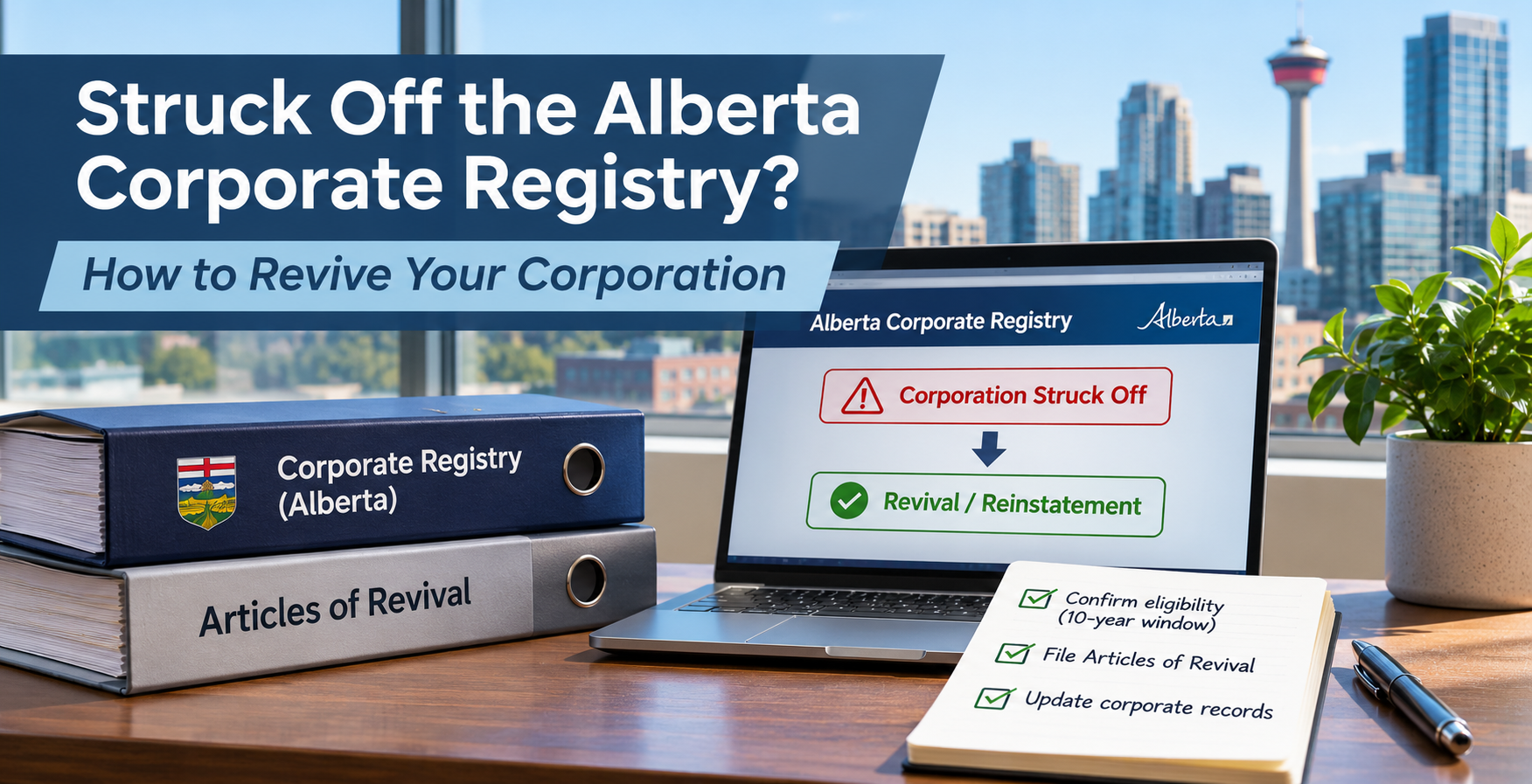
Many business owners only learn their corporation has been struck when something goes wrong. A bank freezes an account, a lender refuses to advance funds, a buyer's lawyer flags it during due diligence, or a lawsuit raises the question of whether the company even exists.
In most cases, the cause is simple: annual returns were not filed with the Alberta Corporate Registry.
Being struck is serious, but it is often fixable. Alberta law allows a struck corporation to be revived, and acting quickly reduces the risks to the business and its owners.
This guide from Libra Law's Business Law team explains what it means when an Alberta corporation is struck, what happens to its property, and how revival works.
Why Alberta Corporations Get Struck
Every Alberta corporation must file an annual return with the Corporate Registry each year. The annual return confirms basic information about the corporation and keeps its registration current.
If annual returns are not filed, the Registrar can begin the process of striking the corporation from the register. Notices are typically sent to the corporation's registered office before this happens. If the registered office address is out of date, the owners may never see those notices.
Common reasons corporations fall behind include:
- the business became inactive but was never formally dissolved
- the registered office address changed and the registry was not updated
- the person or service handling filings left or stopped tracking deadlines
- the owners assumed their accountant was filing annual returns
Our article on the importance of corporate records in Alberta explains why keeping filings and the minute book current matters.
What Does Being Struck Mean?
In Alberta, a corporation that is struck from the register is dissolved. It no longer exists as a legal entity until it is revived.
That has practical consequences. A struck corporation generally cannot:
- enter into valid new contracts in its own name
- deal with its bank accounts in the normal course
- buy, sell, or register property
- start or properly continue a lawsuit
- obtain a certificate of status or good standing
Directors and shareholders who keep operating the business as if nothing happened can expose themselves to added risk, because the corporate entity they are relying on is not there.
What Happens to the Corporation's Property?
When a corporation is dissolved, property it still owns generally passes to the Province of Alberta under the Unclaimed Personal Property and Vested Property Act.
That can include real estate, bank balances, and other assets. Revival generally allows the corporation to recover its property, subject to the legislation and to any rights third parties acquired in the meantime. If too much time has passed, recovery becomes far more difficult.
This is one of the most important reasons to act quickly once you learn the corporation has been struck.
The 10-Year Revival Window
Amendments to Alberta's Business Corporations Act that came into force on May 31, 2022 extended the period for reviving a dissolved corporation from 5 years to 10 years.
An application for revival must generally be made within 10 years of the date of dissolution. After that window closes, revival is no longer available through the standard process, and any claim to property that passed to the Province follows a separate and more limited route.
Who Can Apply for Revival?
Revival can be applied for by an interested person. That usually includes:
- a former director or shareholder
- a creditor of the corporation
- a party to a contract or legal proceeding involving the corporation
- a person with an interest in property the corporation held
Third parties sometimes revive a corporation so they can sue it, or so that property can be properly dealt with.
How Revival Works
The general process for reviving an Alberta corporation involves:
1. Confirm the corporation's status and dissolution date
A corporate search will show whether the corporation is struck and when.
2. Check the corporate name
If the corporation has been dissolved for several years, another business may have registered a similar name. A name search may be required, and the corporation may need a new name if its original name is no longer available.
3. File articles of revival
Articles of revival are filed with the Corporate Registry along with the required fee.
4. Bring the filings up to date
Outstanding annual returns are filed, and any changes to directors or the registered office are updated.
5. Receive the certificate of revival
Once the filings are accepted, the corporation is revived.
6. Clean up the records
The minute book should be updated with any missing resolutions and filings, and banks, lenders, insurers, and key counterparties should be advised that the corporation is back in good standing.
What Revival Does and Does Not Fix
Under the Business Corporations Act, a revived corporation is generally restored as if it had not been dissolved. That can validate many acts carried out while it was struck.
However, revival is subject to rights that other parties acquired during the period of dissolution. If someone obtained legal rights against the corporation or its property while it was struck, revival may not undo those rights.
Tax filings are also separate. Revival with the Corporate Registry does not bring the corporation's Canada Revenue Agency filings up to date. Those must be addressed with the corporation's accountant.
Should You Revive or Dissolve Properly?
Not every struck corporation needs to be brought back to life. If the business is finished, a formal dissolution may be the better way to close it, once property, debts, and tax matters are dealt with.
The decision often turns on whether the corporation still owns property, has outstanding contracts or claims, or is needed for a sale, financing, or estate plan. Our guide to corporate dissolution in Alberta explains the proper steps for closing a corporation.
Frequently Asked Questions
How do I know if my Alberta corporation has been struck?
A corporate search through an Alberta registry agent will show the corporation's current status and the date it was struck, if applicable.
How long do I have to revive a struck Alberta corporation?
An application for revival must generally be made within 10 years of the date the corporation was dissolved.
Do I need to file all missed annual returns?
Generally, yes. Outstanding annual returns are typically filed as part of the revival process.
Is a struck corporation's property lost forever?
Not necessarily. Property of a dissolved corporation generally passes to the Province, and revival can allow it to be recovered, subject to the legislation and to rights acquired by others in the meantime.
Final Thoughts
A struck corporation is usually the result of missed paperwork, not a failed business. But while the corporation is struck, it does not legally exist, its property may pass to the Province, and its ability to contract and operate is compromised.
Revival is often straightforward when it is handled promptly. The longer a corporation stays struck, the more complicated the clean-up can become.
Libra Law's Business Law team helps Alberta business owners revive struck corporations, bring corporate records up to date, and decide whether revival or a formal dissolution is the right step.
Talk to a business lawyer at Libra Law as soon as you learn your corporation has been struck.
Disclaimer: This article is for general informational purposes only and does not constitute legal advice. To obtain advice specific to your situation, please consult a lawyer or qualified professional.
