Legally Binding Contracts in Alberta: Key Principles for Business
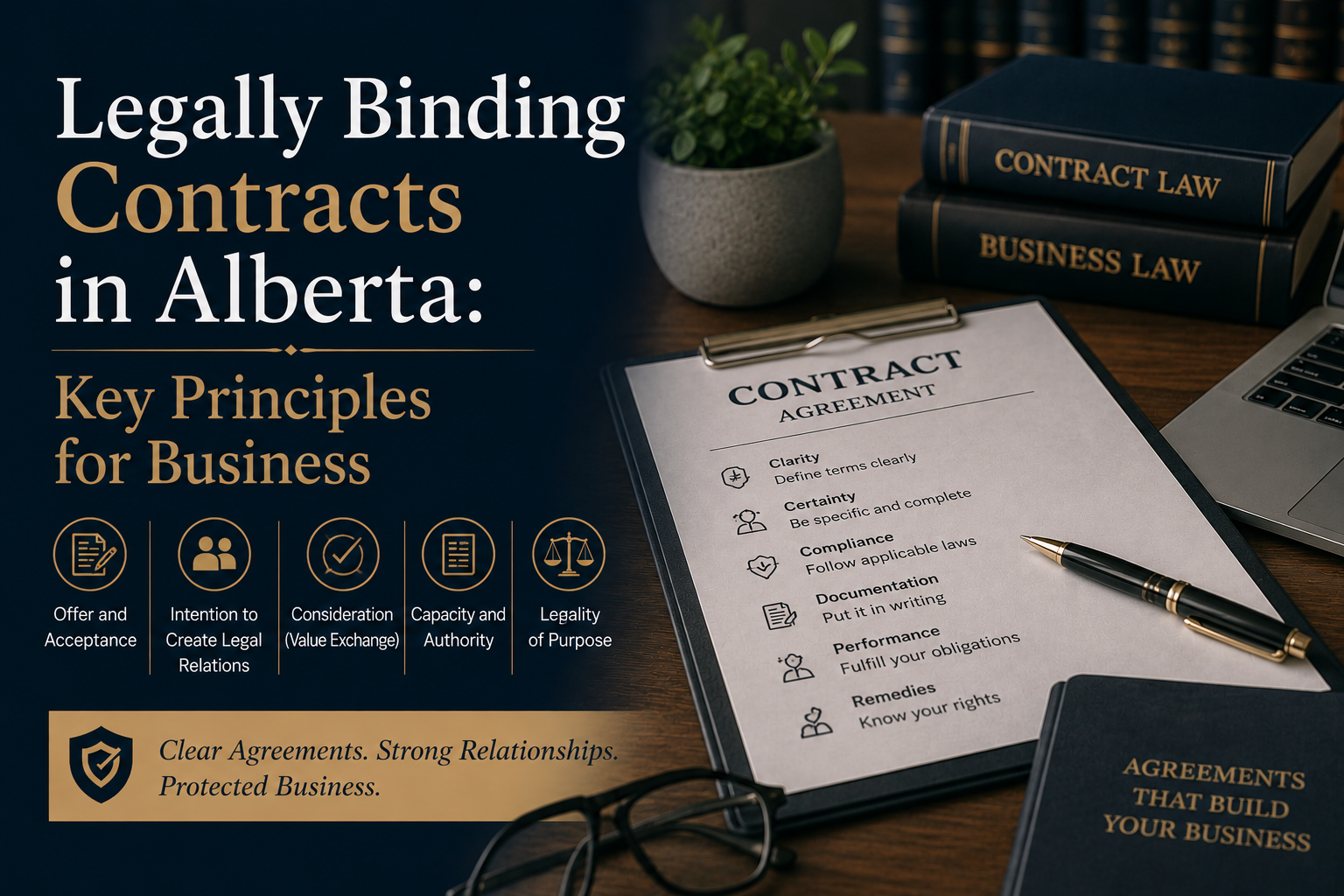
Contracts are the backbone of every business — with customers, suppliers, employees, landlords, and partners. Yet many owners are not entirely sure what makes an agreement legally binding, or where their handshake deals fall short. Understanding the basics helps you protect your business and avoid disputes. Here are the key principles every Alberta business should know.
The core elements of a binding contract
For a contract to be legally binding, several elements generally need to be present:
- Offer — a clear proposal to do (or not do) something on defined terms
- Acceptance — an unqualified agreement to that offer
- Consideration — something of value exchanged both ways, such as money, goods, services, or a promise
- Intention to create legal relations — both sides intend to be legally bound, which is presumed in commercial dealings
- Capacity — the parties are legally able to contract, including having authority to bind a company
- Legality — the purpose of the contract must be lawful
On top of these, the essential terms must be certain enough to be enforced. An "agreement to agree" on key points later is often not a binding contract at all.
Do contracts have to be in writing?
Many oral contracts are perfectly binding — the challenge is proving what was agreed. Some contracts, however, must be in writing to be enforceable, most notably guarantees (see our article on personal guarantees in Alberta) and certain dealings with land. The safe practice for any important arrangement is to put it in writing, which is why we encourage written contracts for small businesses.
Are emails and e-signatures binding?
Yes, often they are. Under Alberta’s Electronic Transactions Act, electronic signatures and email exchanges can create binding contracts. That is convenient, but it also means you should be careful what you agree to in a quick email or text — an informal message can commit your business.
Key terms every business contract should address
- The parties and who has authority to sign
- Scope of work, deliverables, or goods
- Price, payment terms, and timing
- Term, renewal, and how the contract can be ended
- Warranties and what is promised
- Limitation of liability and indemnities
- Confidentiality where relevant
- Dispute resolution and governing law
Common contract mistakes
The disputes we see most often trace back to a handful of avoidable errors: vague or missing terms; using a generic template that does not fit the deal; no signature or no authority to bind the company; ignoring termination and dispute-resolution clauses; and relying on verbal promises that were never written down. When a contract does go wrong, a well-framed demand letter is often the first step — and specialized agreements like a commercial lease deserve particular care.
When to get a lawyer involved
You do not need a lawyer for every purchase order. But for agreements that are high value, long-term, unusual, or drafted on the other side’s paper, a review up front is far cheaper than a dispute later. A lawyer can spot the clause that would have cost you dearly and strengthen your position before you sign.
Frequently asked questions
Is a verbal agreement legally binding in Alberta?
Often yes, if the core elements are present. The problem is proof. Some contracts, such as guarantees and certain land dealings, must be in writing to be enforceable.
Does a contract need to be witnessed?
Most business contracts do not require a witness to be valid. Witnessing can help with proof and is required for certain documents, but the key elements are offer, acceptance, and consideration.
What can make a contract unenforceable?
Reasons include a lack of consideration, uncertainty of essential terms, one party lacking capacity or authority, an illegal purpose, or, in some cases, misrepresentation, duress, or unconscionability.
Need a contract drafted or reviewed? Libra Law helps Alberta businesses put clear, enforceable agreements in place and resolve disputes when they arise. Explore our business law services, call or text +1 (587) 438-2051, or get in touch.
This article provides general information about Alberta law and is not legal advice. Every situation is different. For advice about your specific circumstances, please speak with a lawyer at Libra Law.
