Fresh Consideration: Is Your New Employment Contract Enforceable?
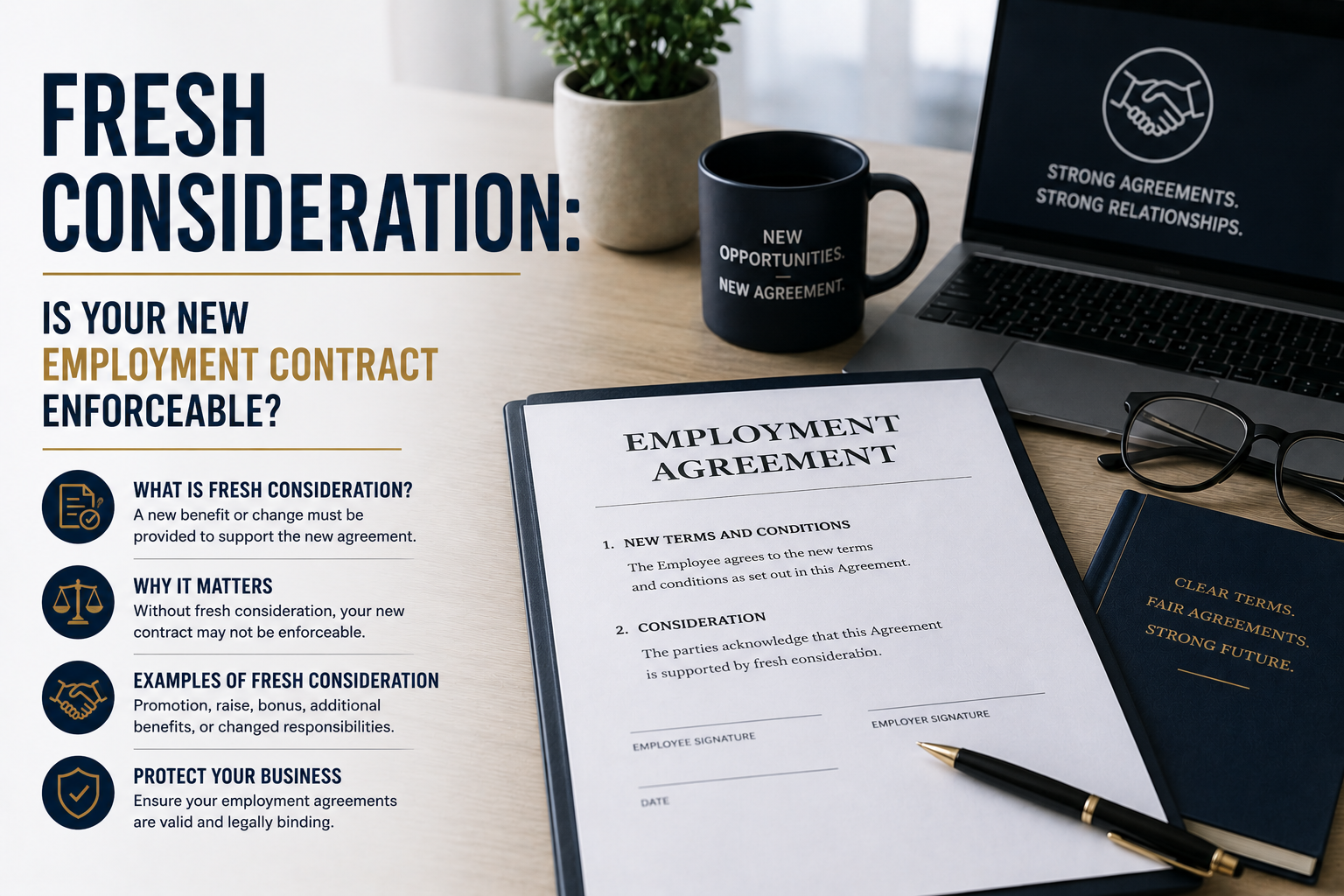
An employer hands a long-time employee a new contract and asks them to sign it. The employee signs, assuming it is now binding. Often it is not. A core principle of contract law, known as consideration, can render a new employment agreement unenforceable when an existing employee is asked to accept new terms without receiving anything new in return. Both employers and employees benefit from understanding how this works.
What Consideration Means
Consideration is the value each party gives to make a contract binding. In a fresh hire, the consideration is straightforward: the employer offers the job and pay, and the employee offers their work. But when someone is already employed and is asked to sign a new contract, that original exchange has already happened. Continuing to do the same job they already had is generally not enough to support new terms.
Why Existing Employees Are Different
This is the heart of the issue. If an employer introduces a new contract, perhaps one that adds a termination clause limiting severance, a non-competition clause, or other restrictions, the employee must receive fresh consideration, meaning something of new value, for those new terms to be enforceable. Simply continuing in a job the employee already holds does not count, because the employee is giving nothing they were not already giving.
Without fresh consideration, a court may find the new contract, or at least its new terms, unenforceable, leaving the employee with the protections of the common law rather than the limits the employer tried to impose.
What Counts as Fresh Consideration
- A signing bonus or raise. A genuine new benefit provided in exchange for accepting the new terms.
- A promotion. A meaningful change in role accompanied by the new agreement.
- Other tangible benefits. Additional vacation, a benefit improvement, or another real advantage the employee was not already entitled to.
The benefit must be real and connected to the new agreement. Token or illusory benefits may not satisfy the requirement.
The Connection to Termination Clauses
Fresh consideration frequently becomes important when employers try to introduce or tighten termination clauses. A termination clause that limits an employee to minimum statutory entitlements can dramatically reduce what they receive on dismissal, but only if the clause is enforceable. If it was added to an existing employee's terms without fresh consideration, it may not hold, and the employee may be entitled to far more. This overlaps with the issues around employment releases and severance.
Guidance for Employers
Employers who want enforceable new contracts should provide genuine fresh consideration, clearly document it, and give employees reasonable time and the opportunity to seek advice before signing. Rolling out new contracts without these steps risks creating agreements that will not survive a challenge.
Timing Matters: Before or During Employment
The cleanest moment to put terms in place is before employment begins. A contract presented and signed as a condition of being hired is supported by the job offer itself, so consideration is not usually an issue. The difficulty arises later, when an employer wants to change the deal mid-stream. At that point, the original bargain is already in place, and the law generally requires a new exchange of value. Employers who understand this distinction can plan accordingly, and employees who understand it can recognize when a mid-employment contract may not bind them.
Know What You Signed
Whether you are an employer rolling out new agreements or an employee who recently signed one, the enforceability of the contract may turn on whether fresh consideration was provided. Libra Law advises Calgary employers and employees on employment contracts and their enforceability. To review your situation, contact Libra Law, learn more about our employment law services, or read more in our articles.
Disclaimer: This article is for general informational purposes only and does not constitute legal advice. To obtain advice specific to your situation, please consult a lawyer or qualified professional.
