Dying Without a Will in Alberta
Many people put off making a will because they assume their estate will automatically go to the right people.
A married person may assume everything will go to their spouse. A parent may assume their children will be taken care of. Someone in a long-term relationship may assume their partner will be treated the same as a spouse.
Sometimes those assumptions are correct. Sometimes they are not.
In Alberta, if you die without a valid will, you are said to have died intestate. When that happens, your estate is divided according to Alberta’s intestacy rules instead of your personal wishes.
Those rules may produce a result that feels fair in a simple family situation. But they can create serious problems in blended families, second marriages, unmarried relationships, separated relationships, or situations involving minor children, business assets, or family conflict.
Libra Law helps individuals and families prepare wills, plan their estates, and understand what happens when someone dies without a will in Alberta.
What Does It Mean to Die Without a Will?
Dying without a will means you pass away without a valid legal document that says who should receive your estate and who should administer it.
When there is no will, Alberta law decides who inherits your estate. You do not get to choose:
- Who administers your estate
- Who receives specific assets
- Who receives sentimental items
- Who manages money for minor children
- Who receives shares in a private corporation
- Who should care for dependants
- Whether certain family members should receive more or less
- Whether gifts should go to friends, charities, or extended family
A will gives you control. Without one, the law applies a default formula.
For help preparing or updating a will, visit Libra Law’s Wills and Estates service page.
What Is an Intestate Estate?
An intestate estate is the part of a person’s estate that is not distributed by a valid will.
In some cases, a person may have no will at all. In other cases, a person may have a will that deals with only part of their estate, leaving the rest to be distributed under intestacy rules.
Not every asset necessarily forms part of the estate. Some assets may pass outside the estate depending on ownership and beneficiary designations.
Examples may include:
- Jointly owned property with right of survivorship
- Life insurance with a named beneficiary
- RRSPs or TFSAs with a named beneficiary
- Pension benefits with a named beneficiary
- Assets held in trust
- Certain corporate or business arrangements
This is why estate planning is not only about writing a will. It is also about making sure asset ownership, beneficiary designations, corporate documents, and estate documents work together.
Who Administers an Estate Without a Will?
If there is no will, there is no named executor.
Instead, someone may need to apply to the court to be appointed as the estate administrator. This person has a role similar to an executor, but they receive authority through a grant of administration rather than through a will.
This can create delays and uncertainty.
Family members may disagree about who should apply. Banks, financial institutions, land titles offices, and other organizations may require court authority before they will release information or allow estate assets to be handled.
If there is a dispute, the process can become even more difficult.
A properly prepared will allows you to choose your executor in advance. Without a will, your loved ones may have to sort out that issue after your death.
For more on executor responsibilities, read Libra Law’s article on Executor Compensation in Alberta.
Who Inherits If You Die Without a Will in Alberta?
In Alberta, the answer depends on your family situation.
The most important questions are usually:
- Did you leave a surviving spouse?
- Did you leave a surviving adult interdependent partner?
- Did you leave children or other descendants?
- Are all of your children also children of your surviving spouse or partner?
- Are any of your children from another relationship?
- Were you separated?
- Are there minor children?
- Are there assets that pass outside the estate?
The rules are especially important for spouses, adult interdependent partners, and children.
What Is an Adult Interdependent Partner?
In Alberta, an unmarried partner may be legally recognized as an adult interdependent partner in certain situations.
A person may qualify as an adult interdependent partner if they lived with the deceased in a relationship of interdependence for at least three years, lived together in a relationship of some permanence and had a child together by birth or adoption, or entered into an adult interdependent partner agreement.
This matters because Alberta’s intestacy rules often treat a surviving spouse and a surviving adult interdependent partner similarly.
However, not every dating relationship, roommate arrangement, or casual relationship qualifies. Whether someone is an adult interdependent partner can become a major issue if there is no will.
If You Leave a Spouse or Adult Interdependent Partner but No Children
If you die without a will and leave a surviving spouse or adult interdependent partner but no descendants, your intestate estate generally goes to that surviving spouse or adult interdependent partner.
This may be a simple result for some couples.
However, it may still create issues if:
- You wanted to leave gifts to parents, siblings, friends, or charities
- You were separated but not divorced
- Someone disputes whether a person was your adult interdependent partner
- You had stepchildren you wanted to include
- Some assets pass outside the estate
- You owned a business or private company shares
- Your estate needs someone specific to administer it
Even when the default distribution seems acceptable, a will is still important because it allows you to choose who manages the estate and how specific assets should be handled.
If You Leave a Spouse or Partner and Children From the Same Relationship
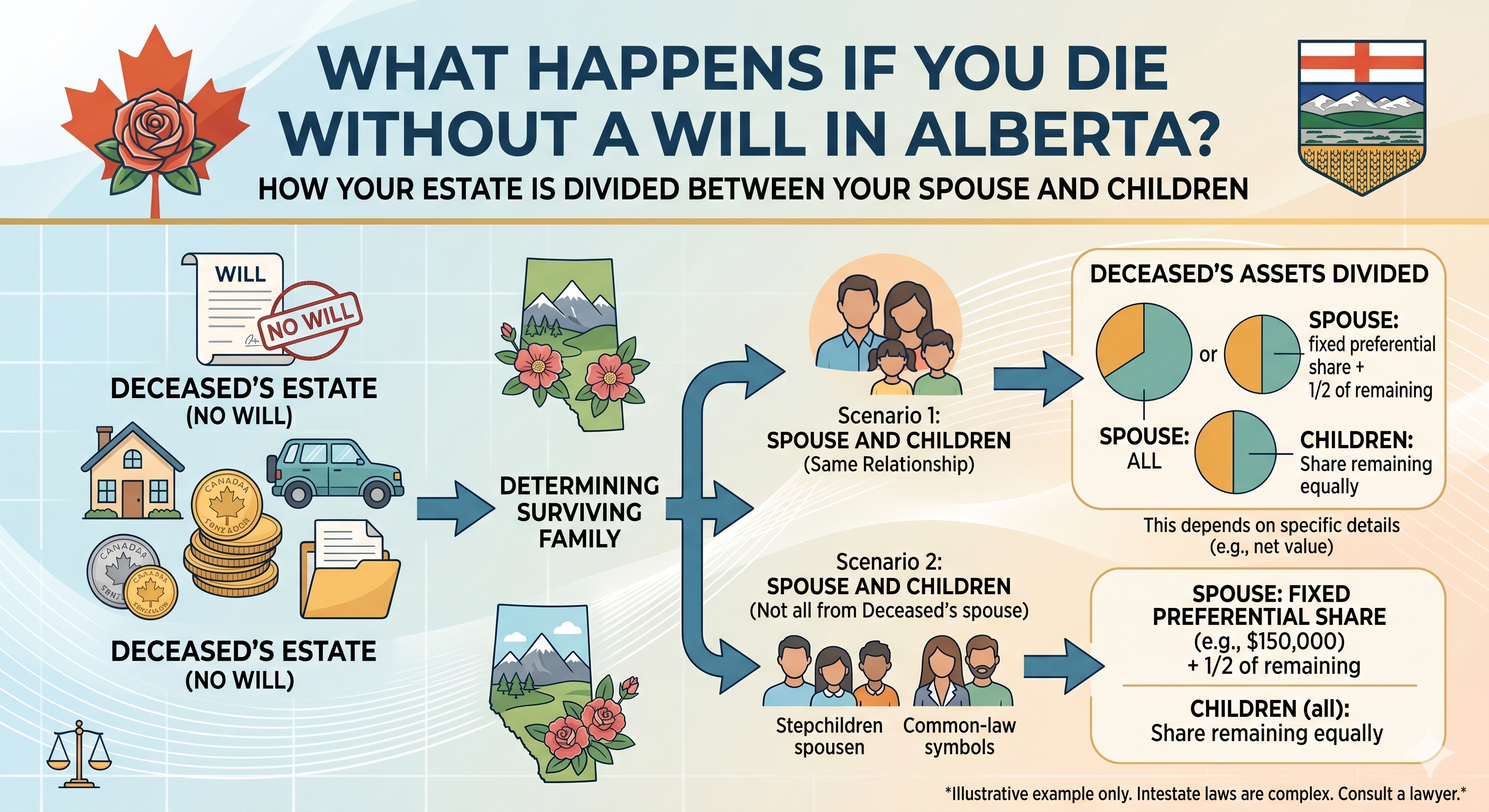
If you die without a will and leave a surviving spouse or adult interdependent partner, and all of your descendants are also descendants of that surviving spouse or partner, your intestate estate generally goes to the surviving spouse or partner.
For example, if you and your spouse have two children together and you have no children from another relationship, your spouse may receive the entire intestate estate.
Many people assume this is always the rule, but it is not.
The result can change significantly if you have children from a previous relationship.
If You Leave a Spouse or Partner and Children From Another Relationship
Blended families require special attention.
If you die without a will and leave a surviving spouse or adult interdependent partner, but one or more of your descendants are not also descendants of that surviving spouse or partner, the estate is divided differently.
In that situation, the surviving spouse or adult interdependent partner is generally entitled to the greater of:
- The prescribed amount, currently $150,000
- 50% of the net value of the intestate estate
The remaining estate is then distributed among the deceased’s descendants according to Alberta’s intestacy rules.
This can surprise families.
For example, if you are remarried and have children from a previous relationship, your surviving spouse may not automatically receive your entire estate. Your children may also be entitled to a share.
This may or may not reflect what you wanted.
A will allows you to make a clear plan instead of relying on a default formula.
What If You Leave Both a Spouse and an Adult Interdependent Partner?
This situation can happen if a person is legally married but separated, and later forms a qualifying adult interdependent relationship with someone else.
If someone dies without a will and leaves both a surviving spouse and a surviving adult interdependent partner, the distribution can become more complicated.
In some cases, the spouse and adult interdependent partner may share the portion that would otherwise go to the spouse or partner. The exact result depends on whether there are descendants and whether the surviving spouse is treated as having predeceased the deceased under Alberta law due to separation.
This is one of the clearest examples of why a will matters.
Without proper planning, your estate may become the subject of conflict between a legal spouse, a current partner, children, and other family members.
What If You Were Separated but Not Divorced?
Separation can affect inheritance rights.
A surviving spouse may be treated differently if the spouses were separated in circumstances recognized by Alberta’s estate legislation. However, separation issues can be fact-specific and may lead to disputes.
This is especially important if:
- You separated but never divorced
- You started a new long-term relationship
- You did not update your estate plan
- You still owned property jointly with your former spouse
- You had children from more than one relationship
- You named a former spouse as beneficiary on insurance or registered accounts
If you separate, divorce, remarry, or enter a new long-term relationship, you should review your will and beneficiary designations as soon as possible.
What If You Have Children but No Spouse or Partner?
If you die without a will and leave descendants but no surviving spouse or adult interdependent partner, your estate generally goes to your descendants.
This usually means your children inherit.
If one of your children has already died but left children of their own, that child’s share may pass down to their descendants according to the applicable distribution rules.
This can become complicated when families include:
- Minor children
- Children from different relationships
- Estranged children
- Adopted children
- Deceased children with children of their own
- Children with disabilities
- Beneficiaries who cannot manage money independently
A will allows you to create trusts, name trustees, and give clear instructions for how money should be managed for children or vulnerable beneficiaries.
If you have a loved one with a disability, you may also want to read Libra Law’s article on Henson Trusts and AISH Benefits in Alberta.
What If You Have Minor Children?
If you die without a will and leave minor children, the situation can become more complicated.
Minor children cannot usually receive and manage a large inheritance directly. Money may need to be held and managed for them until they reach the required age.
Without a will, you lose the opportunity to choose a trustee and set terms for how money should be managed.
A will can address:
- Who should manage money for your children
- At what age children should receive funds
- Whether funds can be used for education, housing, health, or support
- Whether distributions should be staggered over time
- Who should act as guardian or trustee
- What happens if a child has a disability
- How blended-family issues should be handled
Parents should not assume that the default rules will match their wishes.
What About Stepchildren?
Stepchildren are often overlooked in estate planning.
In many cases, stepchildren may not inherit under intestacy rules unless they were legally adopted or otherwise qualify under the applicable legal definitions.
This can create painful outcomes.
For example, a person may help raise a stepchild for many years and want that stepchild to receive part of the estate. But if there is no will, the stepchild may receive nothing unless they have a recognized legal status.
If you want to leave anything to stepchildren, foster children, nieces, nephews, friends, or charities, you should make a will.
What If You Have No Spouse, Partner, or Children?
If you die without a will and leave no spouse, adult interdependent partner, or descendants, Alberta’s intestacy rules move through other relatives.
The estate may go to parents, siblings, nieces and nephews, grandparents, aunts, uncles, cousins, or other relatives depending on who survives you.
If no heirs can be found, the estate may eventually go to the government.
A will allows you to avoid this default hierarchy and leave your estate to the people, charities, or organizations you choose.
What Assets Are Not Controlled by Intestacy Rules?
Some assets may pass outside the estate and may not be divided under intestacy rules.
Examples may include:
- Joint bank accounts with right of survivorship
- Jointly owned real estate with right of survivorship
- Life insurance with a named beneficiary
- RRSPs, RRIFs, or TFSAs with named beneficiaries
- Pension survivor benefits
- Assets held in a trust
- Corporate-owned assets
- Certain payable-on-death arrangements
These assets should still be reviewed carefully. Joint ownership and beneficiary designations can create disputes, especially if they do not match the family’s expectations.
A complete estate plan should coordinate the will with asset ownership and beneficiary designations.
Corporate Assets and Business Ownership
If you own a corporation, dying without a will can create major problems.
Private company shares may form part of your estate, but corporate bank accounts and corporate assets usually belong to the corporation, not directly to your estate.
This distinction can confuse family members and executors.
If you own a business, your estate plan should address:
- Who receives your shares
- Who can manage the corporation
- Who replaces you as director or officer
- Whether a shareholder agreement applies
- Whether the business should be sold, continued, or wound down
- Whether life insurance funds a buyout
- Whether your executor understands the business
- Whether your corporate records are up to date
For more information, read Libra Law’s article on Are Corporate Accounts Part of the Estate?.
Why Blended Families Should Not Rely on Intestacy
Blended families are one of the biggest reasons to make a will.
If you have children from a previous relationship and a current spouse or partner, Alberta’s intestacy rules may divide your estate between them in a way that does not reflect your wishes.
This can create conflict between:
- A surviving spouse and adult children
- A current partner and children from a previous relationship
- Stepchildren and biological children
- Minor children and adult children
- Business partners and family members
- Beneficiaries who expected different treatment
A will can provide clarity and reduce the chance of disputes.
Without a will, your family may be left trying to interpret default rules during an already difficult time.
Why a Will Is About More Than Distribution
A will does more than say who gets what.
A properly prepared will can also:
- Name an executor
- Name alternate executors
- Create trusts for children
- Create trusts for a loved one with a disability
- Deal with personal items
- Address business interests
- Reduce conflict
- Coordinate with tax planning
- Name guardians where appropriate
- Provide instructions for estate administration
- Clarify gifts to charities or friends
- Avoid uncertainty in blended families
Without a will, your family may have no clear instructions.
Common Mistakes People Make
Many people make avoidable mistakes when it comes to wills and intestacy.
Common mistakes include:
- Assuming everything will automatically go to a spouse
- Assuming common-law partners are always treated the same everywhere in Canada
- Forgetting Alberta uses the term adult interdependent partner
- Assuming children from a previous relationship will be treated the same as children from the current relationship
- Forgetting about stepchildren
- Ignoring beneficiary designations
- Owning a business without succession planning
- Not updating a will after separation or divorce
- Not making a will because assets seem simple
- Relying on verbal promises
- Forgetting about minor children
- Not planning for a beneficiary with a disability
- Assuming family members will agree after death
These mistakes can create delays, legal costs, and family conflict.
Common Problems After Someone Dies Without a Will
When someone dies without a will, loved ones may face several challenges.
These may include:
- No named executor
- Court application required for an administrator
- Delays accessing bank accounts
- Uncertainty about who inherits
- Disputes between spouses, partners, and children
- Problems involving minor children
- Stepchildren being excluded
- Blended-family conflict
- Business disruption
- Difficulty locating assets
- Higher legal and administrative costs
- Disputes over personal belongings
- Tax and valuation issues
- Confusion about beneficiary designations
- Delays selling property or distributing funds
A will does not eliminate every possible issue, but it gives your loved ones a clearer roadmap.
Practical Steps If a Loved One Dies Without a Will
If someone in your family dies without a will in Alberta, consider taking the following steps:
- Confirm whether there is truly no will.
- Search personal records, safe deposit boxes, and digital files.
- Contact the deceased’s lawyer, if known.
- Identify the closest surviving relatives.
- Determine whether there is a spouse or adult interdependent partner.
- Identify all children and descendants, including children from previous relationships.
- List estate assets and debts.
- Identify assets with named beneficiaries or joint ownership.
- Avoid distributing assets too quickly.
- Speak with a lawyer about applying for a grant of administration.
Estate administration without a will can be technical. It is usually best to get legal advice before taking major steps.
Practical Steps to Avoid Intestacy
If you want to avoid leaving your family with uncertainty, consider these steps:
- Make a valid will.
- Name an executor and alternate executor.
- Review your will after major life changes.
- Update beneficiary designations.
- Plan for minor children.
- Plan for blended-family situations.
- Address business ownership and corporate shares.
- Consider trusts where appropriate.
- Tell your executor where important documents are located.
- Review your estate plan regularly.
Your estate plan does not need to be complicated to be useful. Even a straightforward will can make a major difference.
If you are preparing your will, Libra Law’s article on Affidavit of Witness to a Will in Alberta explains one document that may help with future estate administration.
How Libra Law Can Help
Dying without a will can create uncertainty for the people you care about most.
Libra Law helps individuals, families, business owners, executors, and administrators understand Alberta estate planning and estate administration. Whether you need to prepare a will, update an old will, plan for a blended family, or deal with an estate where no will exists, our team can help you understand the next steps.
Our team can assist with:
- Wills
- Estate planning
- Estate administration
- Grants of administration
- Executor and administrator guidance
- Trust planning
- Henson trusts
- Business succession planning
- Corporate shares in estates
- Beneficiary planning
- Probate-related documents
A will gives you control over who manages your estate and how your assets are distributed. Without one, Alberta’s default rules decide for you.
Visit our Wills and Estates page or contact Libra Law to discuss your estate planning needs.
This article is for general informational purposes only and does not constitute legal advice. To obtain advice specific to your situation, please consult a lawyer or qualified professional.
FAQs About Dying Without a Will in Alberta
What happens if I die without a will in Alberta?
If you die without a valid will in Alberta, your estate is distributed according to Alberta’s intestacy rules. The result depends on whether you leave a spouse, adult interdependent partner, children, or other relatives.
Does my spouse get everything if I die without a will?
Sometimes. If you leave a spouse or adult interdependent partner and no descendants, your estate generally goes to that spouse or partner. If all of your descendants are also descendants of that spouse or partner, the spouse or partner generally receives the estate. The result can change if you have children from another relationship.
What happens if I have children from a previous relationship?
If you leave a spouse or adult interdependent partner and one or more descendants who are not also descendants of that spouse or partner, the estate may be divided between the spouse or partner and your descendants.
Do stepchildren inherit if there is no will?
Stepchildren may not automatically inherit under intestacy rules unless they were legally adopted or otherwise qualify under the applicable legal definitions. If you want to provide for stepchildren, you should make a will.
Who handles the estate if there is no will?
If there is no will, there is no named executor. Someone may need to apply to the court to be appointed as the estate administrator before they can deal with estate assets.
