Continuance vs Extra-Provincial Registration Alberta
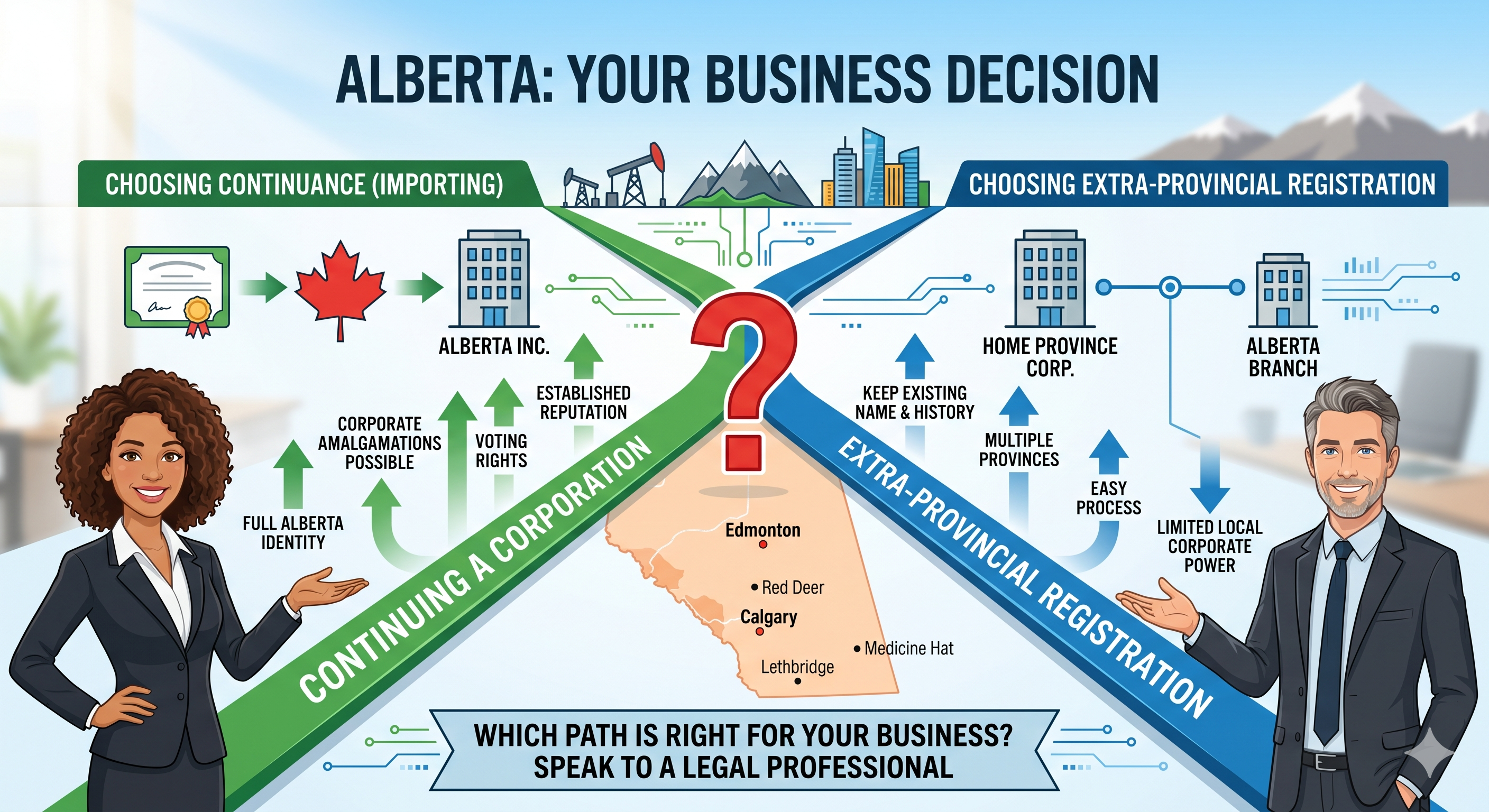
If your corporation was created outside Alberta but now wants to operate in Alberta, you may come across two different options: continuing the corporation into Alberta or extra-provincially registering the corporation in Alberta.
These two options are often confused, but they are not the same.
Extra-provincial registration usually means your corporation keeps its original home jurisdiction but registers to carry on business in Alberta. Continuance means the corporation moves its legal home jurisdiction into Alberta and becomes governed as an Alberta corporation.
Choosing the wrong path can create unnecessary compliance issues, extra filings, governance problems, and confusion about which laws apply to your corporation.
Libra Law helps business owners, directors, shareholders, and professionals understand corporate registration, continuance, and governance requirements before making structural changes to their business.
What Is Extra-Provincial Registration in Alberta?
Extra-provincial registration is the process of registering an out-of-province corporation so it can carry on business in Alberta.
For example, if a corporation was incorporated in British Columbia, Ontario, Saskatchewan, Manitoba, or federally under the Canada Business Corporations Act, it may need to register extra-provincially if it begins operating in Alberta.
Extra-provincial registration does not create a new Alberta corporation. Instead, the existing corporation remains incorporated in its original jurisdiction and becomes registered in Alberta as an extra-provincial corporation.
In simple terms, the corporation is saying:
“We are still incorporated somewhere else, but we are now registered to do business in Alberta.”
This can be useful when a business wants to expand into Alberta without changing its original corporate home.
For a broader overview of business setup requirements, read Libra Law’s guide on Business Registration in Alberta.
What Is Corporate Continuance Into Alberta?
Corporate continuance is different.
Continuance means an existing corporation moves from one jurisdiction into another. When a corporation continues into Alberta, it stops being governed by its previous corporate statute and becomes governed under Alberta corporate law.
In simple terms, the corporation is saying:
“We are moving our corporate home to Alberta.”
A continuance is not the same as creating a brand-new corporation. The corporation usually remains the same legal entity, but its governing jurisdiction changes.
This can matter for shareholders, directors, officers, contracts, annual filings, corporate records, tax planning, and long-term governance.
Continuance may be considered when Alberta becomes the corporation’s primary place of business, when the owners want Alberta law to govern the corporation, or when the business wants to simplify its corporate structure.
If you are deciding whether to incorporate, register, or restructure your corporation, Libra Law’s article on whether you need a lawyer to incorporate may also be helpful.
The Main Difference Between Continuance and Extra-Provincial Registration
The key difference is whether the corporation changes its home jurisdiction.
With extra-provincial registration, the corporation keeps its original jurisdiction and simply registers in Alberta.
With continuance, the corporation changes its corporate home to Alberta.
This difference affects how the corporation is governed, where it files annual returns, which corporate statute applies, and what records and approvals may be required.
Extra-Provincial Registration: When It May Make Sense
Extra-provincial registration may make sense when a corporation wants to carry on business in Alberta but does not want to move its corporate home.
This may be appropriate if:
- The corporation still has its main office or main operations outside Alberta
- The corporation is expanding into Alberta but will continue operating in other provinces
- The shareholders want to keep the original jurisdiction
- The business is testing the Alberta market
- The corporation has existing contracts, financing, licenses, or tax planning tied to its home jurisdiction
- The business wants to avoid a larger corporate restructuring
- The corporation only needs authority to operate in Alberta
For many businesses, extra-provincial registration is a practical expansion step.
For example, an Ontario corporation opening an Alberta office may not need to become an Alberta corporation. It may simply need to register extra-provincially so it can operate in Alberta while remaining an Ontario corporation.
Continuance Into Alberta: When It May Make Sense
Continuance may make sense when Alberta has become the corporation’s main business home.
This may be appropriate if:
- The corporation’s main operations are now in Alberta
- The owners, directors, or management are based in Alberta
- The business wants Alberta corporate law to govern its affairs
- The corporation wants to simplify compliance
- The corporation no longer has a strong connection to its original jurisdiction
- The business is preparing for financing, succession, sale, or restructuring
- The shareholders want the corporation to be treated as an Alberta corporation moving forward
A corporation may also consider continuance if it wants a cleaner corporate structure for future planning.
However, continuance should not be done casually. It may require approvals, filings, review of corporate records, and coordination with the corporation’s existing jurisdiction.
Does Extra-Provincial Registration Create a Separate Corporation?
No.
Extra-provincial registration does not create a separate corporation in Alberta.
The corporation remains the same legal entity. It is simply registered in Alberta as an out-of-province corporation carrying on business in the province.
This is important because the same corporation remains responsible for its contracts, debts, obligations, lawsuits, tax matters, and corporate records.
If a business owner wants a separate Alberta corporation, that is a different legal step. It may require incorporating a new Alberta corporation rather than extra-provincially registering the existing one.
Does Continuance Create a New Corporation?
Usually, no.
Continuance generally allows the existing corporation to continue as the same legal entity under a new corporate jurisdiction.
That means the corporation’s identity may continue, but the law governing the corporation changes.
This is one reason continuance can be attractive. A business may be able to move its corporate jurisdiction without winding up the old corporation and starting again from scratch.
However, the details matter. Before continuing a corporation into Alberta, the corporation should review its governing documents, shareholder approvals, contracts, lender requirements, tax issues, and filing obligations.
What Does “Carrying On Business in Alberta” Mean?
A corporation may need extra-provincial registration if it is carrying on business in Alberta.
This can include situations where the corporation has an office, employees, operations, contracts, real estate, regular business activity, or a meaningful commercial presence in Alberta.
Not every connection to Alberta automatically means registration is required. For example, a single customer or occasional transaction may need a different analysis than opening an Alberta office or regularly providing services in the province.
Because this is fact-specific, it is best to speak with a lawyer before assuming registration is or is not required.
Name Issues in Alberta
Whether a corporation is continuing into Alberta or registering extra-provincially, name issues can become important.
Alberta may require a name search or name review to determine whether the corporation’s name can be used in the province. If the name is too similar to an existing corporation or cannot be used in Alberta, the corporation may need to use an assumed name or make changes.
This can affect branding, contracts, invoices, banking, licensing, and public-facing business materials.
Name issues are especially important if the corporation has an established brand outside Alberta and wants to operate under the same name in Alberta.
Governance Issues to Review Before Choosing
Continuance and extra-provincial registration can both affect corporate governance.
Before choosing a path, the corporation should review:
- Articles of incorporation
- Bylaws
- Shareholder agreements
- Director and officer information
- Corporate minute book
- Share structure
- Unanimous shareholder agreements
- Banking documents
- Financing agreements
- Licenses and permits
- Tax registrations
- Contracts with customers, suppliers, and landlords
- Annual return history
- Corporate recordkeeping
If corporate records are outdated or incomplete, it is often better to address those issues before filing major registration or continuance documents.
For more information, read Libra Law’s article on the Importance of Corporate Records in Alberta.
Shareholder and Director Approval May Be Required
A corporation should not assume that management can choose continuance or registration without reviewing internal approval requirements.
Depending on the jurisdiction, governing documents, and corporate structure, approval may be needed from directors, shareholders, or both.
Continuance is especially important because it changes the corporation’s governing jurisdiction. Shareholders may have rights that must be considered before the corporation moves into Alberta.
Directors should also consider their duties when making decisions about corporate structure. Libra Law’s article on Directors’ Duties and Liability in Alberta explains why directors should understand their responsibilities before approving major corporate decisions.
Tax and Accounting Considerations
Corporate continuity and extra-provincial registration may also have tax and accounting implications.
These may include:
- Provincial tax registration
- Payroll obligations
- GST or HST considerations
- Corporate income tax filings
- Changes to accounting records
- Interprovincial tax allocation
- Business number and account updates
- Payroll remittance issues
- Sales tax obligations in other provinces
A lawyer can help with the legal side of the decision, but business owners should also speak with an accountant or tax advisor before making changes.
This is especially important if the corporation operates in multiple provinces, owns significant assets, has employees in different jurisdictions, or is preparing for a sale or restructuring.
Common Mistakes Businesses Make
Business owners often make mistakes when expanding into Alberta or changing corporate jurisdiction.
Common mistakes include:
- Assuming extra-provincial registration and continuance are the same thing
- Registering in Alberta when continuance would have been more appropriate
- Continuing into Alberta without reviewing shareholder approvals
- Ignoring name availability issues
- Forgetting about annual return obligations in the home jurisdiction
- Failing to update corporate records
- Assuming a federal corporation does not need provincial registration
- Forgetting to review contracts, licenses, leases, and financing documents
- Not considering tax and accounting consequences
- Waiting until a bank, lender, landlord, or government office demands proof of registration
These mistakes can delay business operations and create unnecessary legal costs.
Example: Expanding Into Alberta
Imagine a corporation incorporated in Ontario that wants to open a sales office in Calgary.
The shareholders and directors are still based in Ontario. Most operations remain in Ontario. The corporation simply wants to serve Alberta clients and hire a small Alberta team.
In this case, extra-provincial registration may be the more practical option because the corporation is expanding into Alberta while keeping Ontario as its home jurisdiction.
Example: Moving the Business to Alberta
Now imagine a corporation incorporated in British Columbia. Over time, the owner moves to Alberta, the head office moves to Alberta, the employees are in Alberta, and most of the corporation’s business is now conducted in Alberta.
In that case, the business may want to consider whether continuing into Alberta makes more sense than remaining a British Columbia corporation registered extra-provincially in Alberta.
The answer depends on the corporation’s records, shareholders, contracts, tax planning, and long-term goals.
Which Option Is Better?
There is no one-size-fits-all answer.
Extra-provincial registration may be better when the corporation wants to operate in Alberta but keep its current home jurisdiction.
Continuance may be better when the corporation wants Alberta to become its legal home.
The right option depends on:
- Where the corporation was incorporated
- Where it currently operates
- Where its directors and shareholders are located
- Whether Alberta is the primary place of business
- Whether the corporation operates in multiple provinces
- Whether the corporation has financing or lender obligations
- Whether shareholder approval is needed
- Whether corporate records are up to date
- Whether tax or accounting issues may arise
- The corporation’s long-term business goals
Before choosing, it is worth getting legal advice so the corporation does not create avoidable compliance problems.
How Libra Law Can Help
Corporate registration decisions can have long-term consequences.
Libra Law can help business owners, directors, shareholders, and professionals understand whether extra-provincial registration, continuance, incorporation, or another structure is appropriate.
Our team can assist with:
- Reviewing corporate structure
- Advising on Alberta registration requirements
- Preparing or reviewing corporate documents
- Reviewing shareholder and director approvals
- Updating corporate records
- Advising on governance issues
- Coordinating with accountants and other advisors
- Reviewing related contracts and business documents
Whether you are expanding into Alberta, moving your corporation to Alberta, or trying to clean up an existing corporate structure, Libra Law can help you make the right decision from the start.
Visit our business law services page or contact Libra Law to discuss your corporation’s next step.
This article is for general informational purposes only and does not constitute legal advice. To obtain advice specific to your situation, please consult a lawyer or qualified professional.
FAQs About Continuance and Extra-Provincial Registration in Alberta
What is the difference between continuance and extra-provincial registration in Alberta?
Extra-provincial registration allows an out-of-province corporation to carry on business in Alberta while keeping its original home jurisdiction. Continuance moves the corporation’s legal home jurisdiction into Alberta.
Does extra-provincial registration create a new Alberta corporation?
No. Extra-provincial registration does not create a new corporation. The existing corporation remains the same legal entity and registers to do business in Alberta.
Does continuance into Alberta create a new corporation?
Usually, no. Continuance generally allows the existing corporation to continue as the same legal entity, but under Alberta corporate law.
Does a federal corporation need extra-provincial registration in Alberta?
A federal corporation may still need to register extra-provincially if it carries on business in Alberta. Incorporating federally does not always eliminate provincial registration requirements.
Should I choose continuance or extra-provincial registration?
It depends on your business operations, home jurisdiction, corporate records, shareholder approvals, tax considerations, and long-term plans. A lawyer can help determine which option is more appropriate for your corporation.
