Business Succession Planning in Alberta
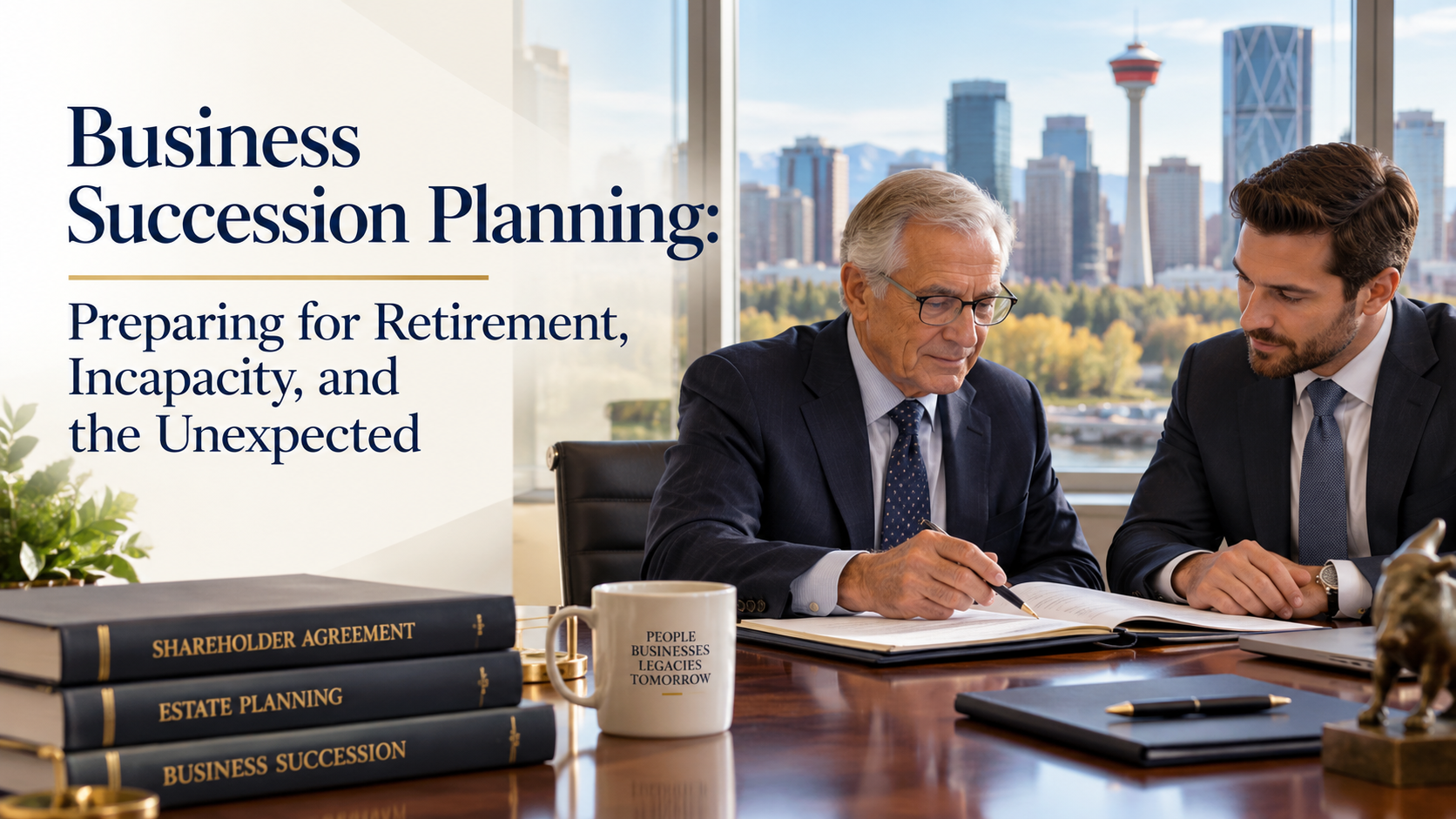
For many entrepreneurs, the business is their largest asset, primary source of income, and a major part of their identity.
Yet business owners often spend more time planning next quarter's revenue than planning what happens when they eventually leave the company.
A strong succession plan is not only about retirement. It should also address incapacity, death, a shareholder dispute, an unexpected offer to buy the company, and other events that can force ownership or management to change quickly.
This guide explains the legal building blocks of business succession planning in Alberta and the questions owners should address while they still have time and leverage.
What Is Business Succession Planning?
Business succession planning is the process of preparing for a future change in ownership, management, or control.
A succession plan may address:
- retirement of the founder
- sale to a third-party buyer
- transfer to children or other family members
- management buyout
- purchase by an existing shareholder
- death of an owner
- long-term incapacity
- departure of a key shareholder
- breakdown of a business partnership
The objective is to avoid a situation where a major life event forces the business to make high-stakes decisions without an agreed process.
Start by Separating Ownership From Management
In small businesses, the same people often own and operate the company. That can make succession planning seem simple until one person exits.
Ask two separate questions:
- Who should own the business in the future?
- Who should manage the business in the future?
The answers may not be the same.
A child may inherit shares but have no interest in running the company. A long-time manager may be the best person to operate the business but may not have the money to purchase it immediately. A surviving spouse may inherit value from the business without wanting any operational role.
A good succession plan addresses both control and economics.
Review the Shareholder Agreement
For a corporation with multiple owners, the shareholder agreement is one of the most important succession documents.
It can establish what happens when a shareholder:
- retires
- dies
- becomes incapable
- wants to sell
- becomes bankrupt
- divorces
- stops working in the business
- breaches the agreement
Buy-sell provisions can create a process for transferring shares rather than leaving the owners to negotiate after the triggering event has already happened.
The agreement should also coordinate with the corporation's articles, bylaws, share structure, and existing financing arrangements.
Build a Clear Valuation Process
One of the fastest ways for a succession event to become a dispute is disagreement over value.
A shareholder agreement or succession plan should address how the business or shares will be valued.
Possible approaches include:
- a fixed value updated regularly
- a formula based on earnings or another financial measure
- independent valuation by a qualified professional
- a process for selecting a valuator if the parties disagree
There is no single method that works for every company.
The important point is to establish the process before one side is a buyer and the other is a seller.
Decide How a Buyout Will Be Funded
A buy-sell clause is only useful if the purchase can actually be completed.
The plan should consider:
- available corporate cash
- personal financing
- bank financing
- staged payments
- life or disability insurance where appropriate
- whether the corporation or the other shareholders will be the purchaser
Funding should be reviewed with legal, tax, insurance, and accounting advisors together.
Coordinate the Business Plan With Your Will
Business succession and estate planning should not be treated as separate projects.
If your will says one thing and your shareholder agreement requires another, your family and business partners may face unnecessary confusion after your death.
For example, the plan should address:
- who receives the economic value of your shares
- whether the shares themselves are transferred or sold
- how the purchase price will be paid to your estate
- whether a surviving spouse or child will become a shareholder
- who has authority to deal with the shares during estate administration
For more detail, see our guide on Death of a Shareholder in a Private Company.
Plan for Incapacity, Not Just Death
Death creates a clear legal event. Incapacity can be more complicated because the owner is still alive but may no longer be able to make decisions.
A complete succession plan should consider:
- an Enduring Power of Attorney
- replacement directors
- signing authority
- shareholder agreement incapacity provisions
- management delegation
- banking access
- temporary decision-making authority
- a potential buyout after long-term incapacity
A corporation that relies on one person for all approvals can be operationally frozen even when it remains legally active.
Clean Up Corporate Records Before a Transition
A future buyer, lender, investor, executor, or family member will rely on the corporation's records.
Before a succession event, make sure the minute book accurately reflects:
- current shareholders
- share issuances and transfers
- directors and officers
- annual resolutions
- dividends
- major corporate transactions
- shareholder agreements
- restrictions on share transfers
Poor records can reduce buyer confidence, delay a sale, and create disputes over who owns what.
See our article on the Importance of Corporate Records in Alberta for more information.
Review Key Contracts for Change-of-Control Problems
A business can have a strong succession plan and still face problems if its major contracts restrict ownership changes.
Review:
- commercial leases
- bank loans
- supplier agreements
- franchise agreements
- licensing agreements
- customer contracts
- shareholder loans
- insurance policies
Some agreements require consent before a change of control, assignment, or sale of the business.
A succession strategy should identify these restrictions early.
Prepare the Next Generation of Management
Legal documents cannot replace operational readiness.
If the business is expected to continue after the founder exits, consider:
- who has customer relationships
- who understands pricing and margins
- who can approve expenses
- who knows the banking arrangements
- who manages key employees
- who can access systems and passwords
- who can make decisions during an emergency
Reducing dependence on one founder usually makes the company more resilient and can also improve its value to a future buyer.
Tax Planning Should Start Early
A share sale, asset sale, family transfer, estate freeze, or redemption can have very different tax consequences.
Succession planning should therefore be coordinated with an accountant or tax advisor before the legal structure is finalized.
Legal documents should support the chosen tax and business strategy, not be prepared in isolation after the fact.
A Practical Business Succession Checklist
Business owners should review the following:
- Who should own the company after you leave?
- Who should manage it?
- Is there a current shareholder agreement?
- What events trigger a mandatory or optional buyout?
- How will shares be valued?
- How will the purchase be funded?
- Does your will align with the shareholder agreement?
- Is your Enduring Power of Attorney appropriate for your business interests?
- Are corporate records current?
- Do major contracts restrict assignment or changes of control?
- Are key employees prepared for a transition?
- Have your lawyer and accountant reviewed the same plan?
Frequently Asked Questions
When should I start business succession planning?
Before you need it. The strongest plans are created while the owners are healthy, working together, and able to negotiate without the pressure of a pending retirement, illness, dispute, or sale.
Is a will enough for a business owner?
Usually not. A will is important, but business owners may also need a shareholder agreement, Enduring Power of Attorney, updated corporate records, buy-sell provisions, and a management continuity plan.
What is a buy-sell agreement?
A buy-sell arrangement establishes when and how an ownership interest can or must be purchased after events such as death, retirement, incapacity, or another shareholder exit.
Can I leave my company to my children?
Potentially, but the legal, tax, financing, and governance consequences should be planned carefully. The person who inherits value does not necessarily need to be the person who manages the company.
Final Thoughts
Business succession planning is ultimately about control, continuity, and value.
A well-prepared owner decides in advance how the company should respond to retirement, incapacity, death, or an unexpected exit. Without that planning, family members, shareholders, employees, and lenders may be forced to solve the problem during a crisis.
Libra Law helps Alberta business owners coordinate shareholder agreements, corporate records, succession documents, and estate planning so the business plan and personal plan work together.
Talk to Libra Law's Business Law team about building or updating your business succession plan.
Disclaimer: This article is for general informational purposes only and does not constitute legal advice. To obtain advice specific to your situation, please consult a lawyer or qualified professional.
